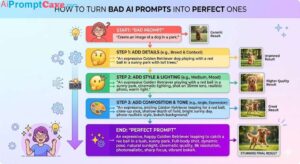
Prompt engineering is one of the most important skills in the age of artificial intelligence. As AI tools like ChatGPT, image generators, and automation systems become more common, the way you communicate with them directly affects the quality of results you get.
In simple terms, prompt engineering is the practice of designing and refining instructions (prompts) to get the best possible output from an AI model.
This guide will walk you through everything you need to know as a beginner: what prompt engineering is, how it works, why it matters, and how you can start using it effectively today.
Understanding the Basics of Prompt Engineering
To understand prompt engineering, you first need to understand what a “prompt” is.
A prompt is the input you give to an AI model. It can be a question, a command, or a detailed instruction.
For example:
“Write a blog about healthy eating”
“Explain quantum physics in simple terms”
“Generate a futuristic city image at sunset”
The AI reads your prompt and generates a response based on it.
Now here’s the key idea:
The better your prompt, the better your output.
This is where prompt engineering comes in.
Prompt engineering is the skill of crafting prompts in a way that guides the AI to produce accurate, useful, creative, or structured responses.
Why Prompt Engineering Matters
AI models are powerful, but they are not mind readers. They rely completely on the instructions you provide.
If your prompt is vague, the output will also be vague. If your prompt is clear and detailed, the output becomes significantly better.
Example:
Bad prompt:
“Write about cars”
Better prompt:
“Write a 1000-word article explaining electric cars, their benefits, disadvantages, and future trends in simple language for beginners.”
The second prompt gives structure, direction, and context. This is the essence of prompt engineering.
How AI Models Interpret Prompts
AI models like ChatGPT don’t “understand” language the way humans do. Instead, they analyze patterns from massive amounts of text data.
When you give a prompt, the AI:
Breaks it into tokens (small pieces of text)
Analyzes relationships between words
Predicts the most likely response based on training data
This means small changes in wording can produce completely different results.
For example:
“Explain AI”
“Explain AI in simple terms with real-life examples for beginners”
These two prompts will generate very different outputs.
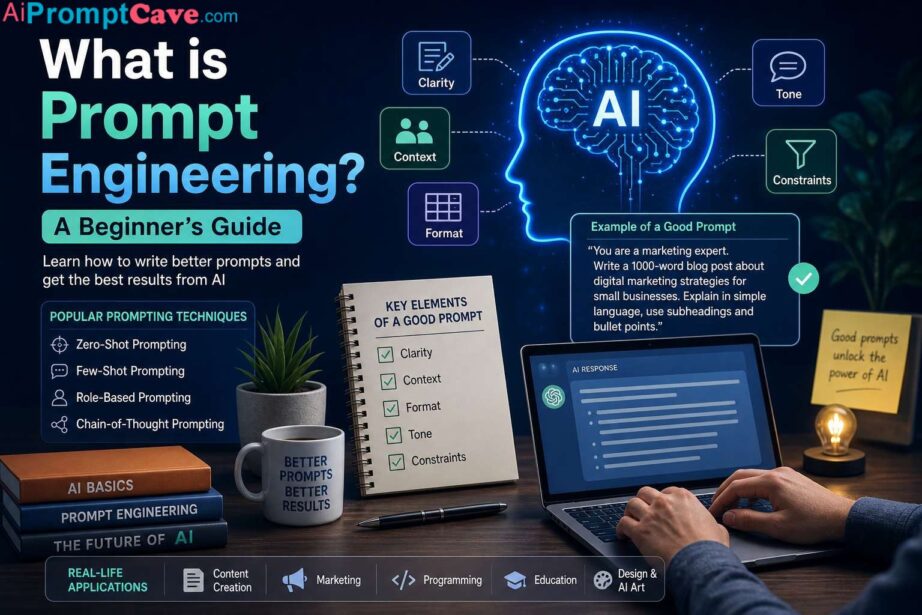
Key Elements of a Good Prompt
A strong prompt usually contains several important components:
1. Clarity
Be specific about what you want.
Instead of:
“Write about marketing”
Use:
“Write a beginner-friendly guide about digital marketing strategies for small businesses”
2. Context
Give background information to help the AI understand the situation.
Example:
“You are a marketing expert. Explain SEO to a small business owner who has no technical knowledge.”
3. Format
Tell the AI how you want the answer structured.
Example:
“Write in bullet points” “Give step-by-step instructions” “Write in a 5-paragraph essay format”
4. Tone
You can control the style of writing.
Example:
Formal
Casual
Professional
Friendly
Persuasive
5. Constraints
Set limits such as word count or complexity.
Example:
“Explain in under 300 words for beginners”
Types of Prompting Techniques
Prompt engineering is not just about writing instructions. There are several techniques that help improve results.
1. Zero-Shot Prompting
You give the AI a task without examples.
Example:
“Translate this sentence into French”
2. Few-Shot Prompting
You provide examples to guide the AI.
Example:
English: Hello → French: Bonjour English: Thank you → French: Merci Now translate: Good morning
3. Role-Based Prompting
You assign a role to the AI.
Example:
“You are a financial advisor. Explain how to save money effectively.”
This improves accuracy and tone.
4. Chain-of-Thought Prompting
You ask the AI to think step by step.
Example:
“Solve this math problem step by step and explain your reasoning.”
This technique improves reasoning performance.
Real-Life Applications of Prompt Engineering
Prompt engineering is not just theoretical. It is used in many industries.
1. Content Creation
Writers use prompts to generate blog posts, scripts, and social media content.
2. Marketing
Marketers use prompts to create ad copy, email campaigns, and SEO content.
3. Programming
Developers use prompts to generate code, debug errors, and explain algorithms.
4. Education
Students use prompts to simplify complex topics and create study notes.
5. Design and AI Art
AI image tools rely heavily on prompts to generate visuals.
Example:
“A cinematic futuristic city at night with neon lights and flying cars”
Common Mistakes in Prompt Engineering
Beginners often make simple mistakes that reduce output quality.
1. Being Too Vague
Bad:
“Write about business”
Better:
“Write a guide about starting a small online business with low investment”
2. Overloading the Prompt
Too much unnecessary information can confuse the AI.
3. Not Specifying Format
Without format instructions, output may be unstructured.
4. Ignoring Iteration
Good prompts are rarely perfect on the first try. Refinement is key.
How to Improve Your Prompt Engineering Skills
Becoming good at prompt engineering requires practice and experimentation.
1. Test Different Variations
Change wording and compare outputs.
2. Study Outputs
Analyze why one prompt worked better than another.
3. Use Templates
Build reusable prompt structures.
Example template:
“Act as [role]. Explain [topic] in [format] for [audience].”
4. Learn from AI Responses
Sometimes the AI itself gives clues on how to improve prompts.
Future of Prompt Engineering
Prompt engineering is becoming a valuable skill in the AI era. As AI systems evolve, the way we interact with them will also change.
In the future:
Prompt engineering may become part of digital literacy
Businesses will hire prompt engineers
AI tools will become more conversational but still require structured input
Automation will rely heavily on well-designed prompts
Some experts even believe prompt engineering will be as important as basic computer skills.
Prompt Engineering for Beginners: Step-by-Step Start
If you’re just starting, here’s a simple way to begin:
Step 1: Start Simple
Ask basic questions to AI tools.
Step 2: Add Detail
Gradually improve your prompts with context and instructions.
Step 3: Experiment
Try different styles and tones.
Step 4: Compare Results
See how changes affect output.
Step 5: Build a Prompt Library
Save your best prompts for reuse.
Final Thoughts
Prompt engineering is not just a technical skill—it’s a communication skill.
The way you talk to AI determines how useful it becomes for you. Whether you are writing content, generating images, learning new topics, or building applications, mastering prompts will significantly improve your results.
As AI continues to grow, one thing becomes clear:
Those who learn how to communicate with AI effectively will have a major advantage in the digital world.
Start simple, keep experimenting, and refine your approach. Over time, you will naturally become skilled at designing powerful prompts that unlock the full potential of AI.