Prompt Engineering has become one of the most important skills in the age of artificial intelligence, especially with the rapid growth of large language models and AI content generation tools. At its core, prompt engineering is simple: you give instructions to an AI model and receive a response. However, in practice, the quality of your prompt directly determines the quality of the output.
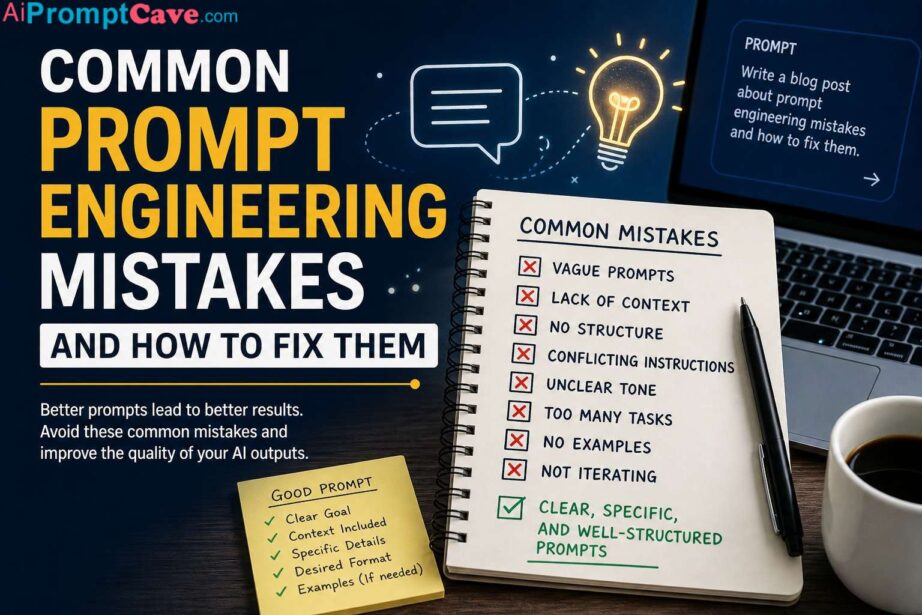
Many users, both beginners and advanced, make common mistakes that lead to weak, inaccurate, or irrelevant results. These mistakes are not random; they follow patterns that can be identified, understood, and fixed. In this article, we will explore the most common prompt engineering mistakes and provide practical solutions to improve your results significantly.
1. Writing Vague and Unclear Prompts
The Problem
One of the most frequent mistakes is using overly general instructions such as:
“Write a good article about marketing”
“Create a beautiful image”
“Explain artificial intelligence”
These prompts lack clear direction, so the model has to guess your intent. As a result, the output is often generic and not aligned with what you actually need.
Why This Happens
AI models do not read minds. They rely entirely on the information provided in the prompt. If the input is vague, the output will also be vague.
The Fix
Be as specific as possible:
Instead of:
“Write an article about marketing”
Use:
“Write a 1500-word article about digital marketing strategies for beginners, including real-life examples and actionable tips”
The more detail you provide, the better the result.
2. Ignoring Context
The Problem
Another common mistake is giving instructions without any background information.
For example:
“Write a summary”
This is unclear because it does not specify what should be summarized or for whom.
Why Context Matters
Context helps the model understand the purpose of the task. Without it, the output becomes generic and less useful.
The Fix
Always include relevant background:
Who is the target audience?
What is the goal of the content?
Where will it be used?
Example:
“Write a simplified summary of a scientific article about solar energy for high school students”
3. Not Specifying Format or Structure
The Problem
Many users request content without defining the structure.
For example:
“Write an article about e-commerce”
This leaves the model guessing about length, structure, and formatting.
The Result
The output may be too short, too long, or poorly organized.
The Fix
Clearly define the structure:
Word count
Sections or headings
Bullet points or paragraphs
Example:
“Write a 2000-word article about e-commerce, including an introduction, five main sections, and a conclusion with practical advice”
4. Using Conflicting Instructions
The Problem
Some prompts contain contradictory requirements such as:
“Write a very long article in 200 words”
“Explain in detail but keep it extremely short”
Why This Is a Problem
The model cannot satisfy conflicting instructions, which leads to low-quality or inconsistent outputs.
The Fix
Ensure your instructions are logically consistent:
If you want detail, allow more word count
If you want short content, avoid asking for deep explanations
5. Not Defining Tone and Style
The Problem
Failing to specify tone leads to unpredictable writing styles.
For example:
“Write an article about AI”
The output could be:
Academic
Casual
Technical
Mixed style
The Fix
Always define the tone:
Professional
Friendly
Beginner-friendly
Marketing-focused
Example:
“Write a professional and engaging article about artificial intelligence in business”
6. Overloading the Prompt with Unnecessary Details
The Problem
Some users include too many irrelevant details that confuse the model.
Example:
“Write an article about cars including the weather, time of day, and background scenery details”
Why This Hurts Results
Too many unnecessary details distract from the main task.
The Fix
Focus only on important elements:
Goal
Audience
Output type
Let the model handle minor creative details.
7. Not Iterating or Improving Prompts
The Problem
Many users write a prompt once and expect perfect results immediately.
Why This Is a Mistake
Prompt engineering is an iterative process, not a one-time action.
The Fix
Improve your prompt step by step:
Start simple
Add clarity
Add structure
Refine tone
Optimize output format
Each iteration improves results significantly.
8. Not Using Examples in Prompts
The Problem
Without examples, the model may misinterpret the desired style or format.
The Fix
Include examples to guide output.
For example:
“Write a marketing ad similar to this structure: Hook → Benefit → Call to Action”
Or:
“Use a tone similar to beginner-friendly educational blogs that explain step-by-step processes”
Examples dramatically improve accuracy.
9. Mixing Too Many Tasks in One Prompt
The Problem
Some users ask for multiple tasks at once, such as:
Write an article
Summarize it
Turn it into an ad
Create SEO titles
Why This Is Inefficient
The model may skip steps or produce incomplete results.
The Fix
Break tasks into separate prompts or structure them clearly:
Better approach:
Generate article
Then summarize
Then create ad version
Then generate SEO title
10. Not Thinking Like You Are Talking to a Person
The Problem
Many prompts are written like rigid commands instead of clear communication.
The Fix
Think of the AI as a smart assistant:
Instead of:
“Make marketing plan”
Use:
“Create a simple 30-day marketing plan for a new online store targeting customers in Egypt, with clear daily steps”
This improves clarity and results.
How to Write a Perfect Prompt
A strong prompt usually includes:
1. Goal
What do you want?
2. Context
Who is it for and why?
3. Details
Length, structure, and requirements
4. Constraints
What to avoid or include
5. Example (optional)
A reference style or format
Example of a Strong Prompt
“Write a 2000-word article about the benefits of digital marketing for small businesses in Egypt. The article should be beginner-friendly and easy to understand. Include an introduction, five main sections, and a conclusion with practical advice. Add real-life examples and avoid technical jargon.”
Conclusion
Prompt engineering is not just about writing instructions; it is about communicating effectively with AI systems. Most common mistakes—such as being vague, ignoring context, or failing to structure prompts—can significantly reduce the quality of results.
The good news is that these mistakes are easy to fix. By being clear, structured, and intentional with your prompts, you can dramatically improve the quality of AI-generated content.
With practice, prompt engineering becomes a powerful skill that helps you unlock the full potential of artificial intelligence in writing, marketing, design, and problem-solving.