Prompt engineering has quickly become one of the most valuable skills in the AI era. Whether you’re using ChatGPT, AI image generators, coding assistants, or automation tools, the quality of your results depends heavily on how you write your prompts.
A prompt is not just a question—it is an instruction, a structure, and a form of communication with an AI system. The better your prompt, the more powerful, accurate, and useful the output becomes.
In this article, you will learn 10 powerful prompt engineering techniques that can dramatically improve your results, whether you’re a beginner or already working with AI tools.
1. Zero-Shot Prompting (Ask Directly Without Examples)
Zero-shot prompting is the simplest form of interacting with AI. You give a direct instruction without any examples.
Example:
“Explain machine learning in simple terms.”
The AI relies entirely on its training data to generate a response.
When to use it:
Quick answers
General explanations
Simple tasks
Why it works:
Modern AI models are trained on massive datasets, so they can often perform tasks without examples.
However, zero-shot prompting can sometimes produce generic or incomplete answers, especially for complex tasks.
2. Few-Shot Prompting (Teach the AI with Examples)
Few-shot prompting improves accuracy by providing examples before asking the AI to complete a task.
Example:
English: Hello → French: Bonjour English: Goodbye → French: Au revoir English: Thank you → ?
Why it works:
The AI detects patterns and applies them to new inputs.
When to use it:
Translation tasks
Classification
Structured outputs
Few-shot prompting is one of the most effective ways to guide AI behavior without fine-tuning a model.
3. Role-Based Prompting (Assign a Personality or Job)
Role-based prompting means assigning the AI a specific identity or profession.
Example:
“You are an experienced business consultant. Explain how a small business can increase profits.”
Why it works:
It changes the tone, depth, and perspective of the response.
Prompt chaining involves splitting a large task into smaller steps.
Example:
Instead of asking:
“Write a complete business plan”
Break it into:
“Generate a business idea”
“Create a target audience analysis”
“Write a marketing strategy”
“Build a financial plan outline”
Why it works:
AI performs better on smaller, focused tasks than large complex ones.
Benefits:
Higher accuracy
Better structure
More control over output
This technique is widely used in automation and AI workflows.
Bonus: Combining Techniques for Maximum Power
The real power of prompt engineering comes from combining techniques.
Example combined prompt:
“You are a professional SEO expert. Write a 1000-word beginner guide about keyword research. Use bullet points, include step-by-step instructions, avoid technical jargon, and explain everything in simple language for new bloggers.”
This prompt uses:
Role-based prompting
Constraint-based prompting
Output formatting
Context injection
The result is dramatically better than a simple prompt.
Real-World Applications of Prompt Engineering
Prompt engineering is used in many industries:
1. Content Creation
Blog posts, articles, scripts, and social media posts.
2. Marketing
Ad copy, email campaigns, SEO strategies.
3. Programming
Code generation, debugging, and documentation.
4. Education
Summaries, explanations, tutoring assistance.
5. Business Automation
Customer support, reporting, workflow automation.
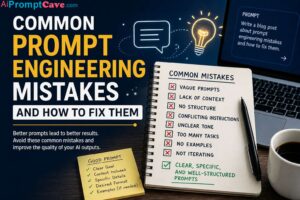
Common Mistakes to Avoid
Even with powerful techniques, beginners often make mistakes:
1. Vague instructions
AI cannot guess your intent.
2. Overloading prompts
Too much information can confuse the model.
3. No structure
Unformatted prompts lead to unstructured answers.
4. Not iterating
First output is rarely the best.
Future of Prompt Engineering
Prompt engineering is evolving rapidly. In the future:
AI tools will become more interactive
Prompting may turn into natural conversation design
Businesses will rely heavily on prompt experts
Automation systems will depend on structured prompting
Some experts believe prompt engineering will become a core digital skill, similar to coding or writing.
Final Thoughts
Prompt engineering is more than just writing instructions—it is the art of communicating with AI effectively.
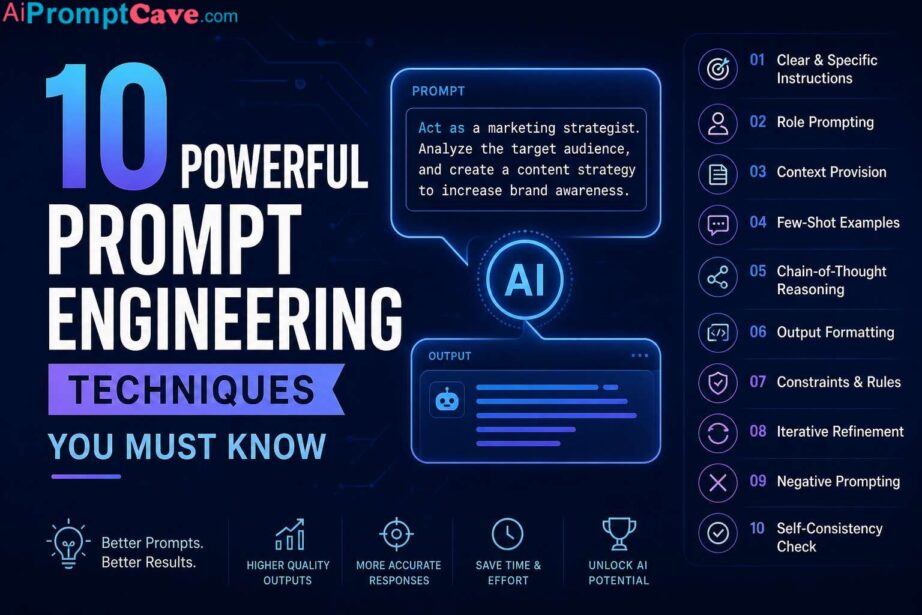
By mastering these 10 techniques, you can dramatically improve your results:
Zero-shot prompting
Few-shot prompting
Role-based prompting
Chain-of-thought reasoning
Instruction refinement
Output formatting
Context injection
Constraint-based prompting
Iterative prompting
Prompt chaining
The key takeaway is simple:
Better prompts = better AI results.
Start experimenting, refine your style, and build your own prompt library. Over time, you will develop a strong intuition for how to get exactly what you want from AI systems.
Prompt engineering is not just a skill—it is a superpower in the modern digital world.