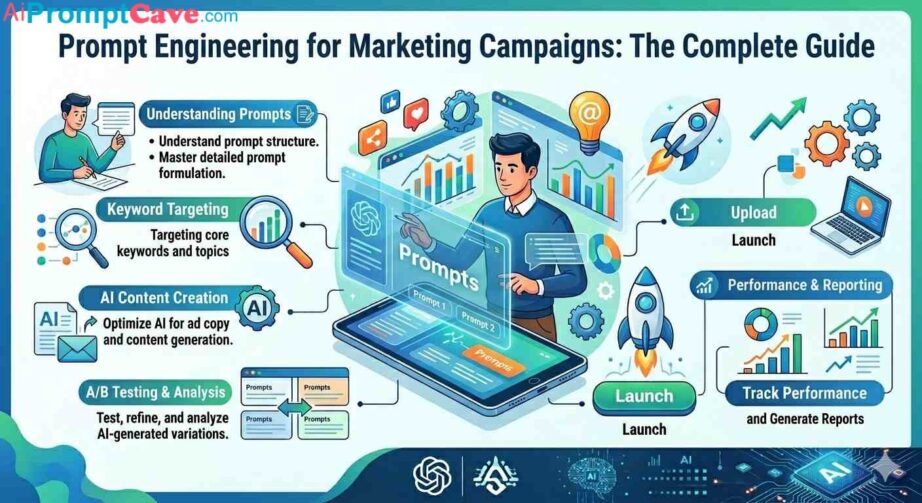
In today’s fast-moving digital landscape, marketing success is no longer just about creativity it’s about speed, personalization, and data-driven execution. Artificial intelligence has transformed how marketers plan, create, and optimize campaigns. At the center of this transformation lies a powerful, often underestimated skill: prompt engineering.
Prompt engineering is not just about asking AI to “write an ad” or “generate ideas.” It’s about strategically designing instructions that guide AI to produce high-converting, targeted, and brand-aligned marketing outputs.
This in-depth guide will show you how to use prompt engineering to build better marketing campaigns from ideation to execution while improving efficiency, consistency, and performance.
What is Prompt Engineering in Marketing?
Prompt engineering in marketing refers to the process of crafting precise, structured instructions that guide AI tools to generate marketing assets such as:
Ad copy
Email campaigns
Landing pages
Social media content
Product descriptions
SEO articles
Brand messaging
Instead of relying on generic outputs, marketers use engineered prompts to control tone, audience targeting, structure, and conversion goals.
Why Prompt Engineering is a Game-Changer for Marketers
Traditional marketing workflows are time-consuming. Brainstorming, writing, editing, testing—it all takes hours or days.
With prompt engineering, you can:
1. Generate Content Faster
What used to take hours can now take minutes.
2. Scale Campaigns Efficiently
Create multiple variations of ads, emails, and posts instantly.
3. Improve Personalization
Tailor messaging to different audiences with precision.
4. Maintain Brand Consistency
Use structured prompts to keep tone and messaging aligned.
5. Increase Conversion Rates
Well-crafted prompts lead to sharper, more persuasive outputs.
The Core Components of a Marketing Prompt
A powerful marketing prompt usually includes the following elements:
1. Role
Define who the AI should act as.
“You are a senior digital marketing strategist…”
2. Objective
Clearly state the goal.
“Create a high-converting Facebook ad…”
3. Target Audience
Specify who the message is for.
“Target audience: small business owners with limited budgets…”
4. Tone & Style
Control the brand voice.
“Use a persuasive yet friendly tone…”
5. Format
Define the structure.
“Write 3 variations with headlines and descriptions…”
6. Constraints
Set limits.
“Keep under 150 words and avoid technical jargon…”
Example of a High-Quality Marketing Prompt
“You are a professional copywriter. Create 3 high-converting Facebook ad variations for a fitness app targeting busy professionals aged 25–40. Focus on convenience and time-saving benefits. Use a persuasive tone, include a strong call-to-action, and keep each variation under 120 words.”
This level of detail dramatically improves output quality.
Prompt Engineering for Different Marketing Channels
1. Social Media Campaigns
AI can generate engaging posts tailored for platforms like Instagram, Facebook, and Twitter.
Example Prompt:
“Create 5 Instagram captions for a luxury skincare brand. Use an elegant tone, include emojis, and add relevant hashtags.”
2. Email Marketing Campaigns
Prompt engineering helps create subject lines, body content, and CTAs.
Example:
“Write a promotional email for a limited-time sale. Include a catchy subject line, engaging intro, and strong CTA. Keep tone urgent but friendly.”
3. Paid Advertising (PPC)
AI can generate multiple ad variations for testing.
Example:
“Generate 5 Google Ads headlines and descriptions for an online course about digital marketing. Focus on career growth and high income potential.”
4. Landing Pages
AI can assist in structuring high-converting pages.
Example:
“Write a landing page for a SaaS tool that improves productivity. Include headline, subheadline, benefits, features, testimonials, and CTA.”
5. SEO Content
Prompt engineering helps create optimized blog posts.
Example:
“Write a 1500-word SEO article about email marketing strategies for beginners. Include headings, keywords, and actionable tips.”
Advanced Prompt Techniques for Marketing
1. Persona-Based Prompting
Define a detailed customer persona.
“Target a 30-year-old entrepreneur struggling with time management…”
This improves emotional relevance.
2. A/B Testing Prompts
Generate multiple variations for testing.
“Create 5 ad variations with different emotional angles: urgency, curiosity, fear, excitement, trust.”
3. Emotional Trigger Prompting
Guide AI to use specific psychological triggers:
Fear of missing out (FOMO)
Social proof
Scarcity
Authority
Example:
“Write an ad using urgency and scarcity to drive immediate action.”
4. Storytelling Prompts
Humans connect with stories.
“Write a short story-based ad about a customer who transformed their life using this product.”
5. Funnel-Specific Prompting
Tailor prompts to different stages:
Awareness
Consideration
Conversion
Example:
“Create content for the awareness stage explaining the problem without selling.”
Real Campaign Workflow Using Prompt Engineering
Here’s how a marketer can build a full campaign:
Step 1: Research
Prompt:
“Analyze the target audience for a fitness app and list pain points.”
Step 2: Messaging
Prompt:
“Create 3 core value propositions based on these pain points.”
Step 3: Content Creation
Prompt:
“Write ads, emails, and social posts based on these value propositions.”
Step 4: Optimization
Prompt:
“Suggest improvements to increase conversion rates.”
Step 5: Scaling
Prompt:
“Generate 10 variations of the best-performing ad.”
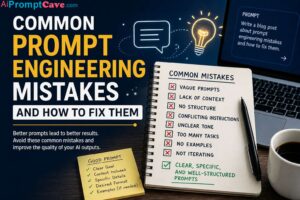
Common Mistakes in Marketing Prompts
1. Being Too Generic
Generic prompts lead to generic results.
2. Ignoring Audience
Without a defined audience, messaging becomes weak.
3. No Clear Goal
Always define what success looks like.
4. Overloading Instructions
Too much detail can confuse AI.
5. Not Iterating
Refinement is key to improvement.
How to Build a Prompt Library for Marketing
Successful marketers don’t write prompts from scratch every time.
They build a prompt library.
Examples:
Ad copy templates
Email templates
SEO article prompts
Product description prompts
This saves time and ensures consistency.
The Role of AI + Human Creativity
AI is not replacing marketers—it’s enhancing them.
AI can:
Generate ideas
Speed up content creation
Provide insights
Humans still:
Define strategy
Understand emotions
Make final decisions
The best results come from combining both.
Future of Prompt Engineering in Marketing
Prompt engineering will continue evolving as AI improves.
Future trends include:
1. Hyper-Personalization
AI will create content tailored to individuals.
2. Real-Time Campaign Optimization
Prompts will adjust based on live data.
3. Voice & Multimodal Prompts
Beyond text—voice, images, and video prompts.
4. Automation at Scale
Entire campaigns generated and optimized automatically.
Practical Tips to Master Prompt Engineering
Start simple, then refine
Be clear and specific
Always define audience
Use structure and formatting
Test multiple variations
Analyze outputs and improve
Example: Full Campaign Prompt
Here’s a powerful all-in-one prompt:
“You are a senior marketing strategist. Create a full marketing campaign for a productivity app targeting remote workers aged 25–45. Include social media posts, email campaign, ad copy, and landing page content. Use a friendly and motivating tone, focus on time-saving benefits, and include strong calls-to-action.”
Final Thoughts
Prompt engineering is quickly becoming a core skill in digital marketing.
It allows you to:
Work faster
Scale campaigns
Improve personalization
Increase conversions
The marketers who master this skill will have a significant competitive advantage.
The key takeaway is simple:
AI is only as powerful as the prompts you give it.
Learn how to communicate clearly, experiment continuously, and refine your prompts—and you will unlock the full potential of AI in marketing campaigns.