Artificial intelligence image generation has changed the way creators, marketers, designers, and content creators produce visuals. Today, a simple prompt can generate everything from cinematic portraits and luxury advertisements to hyper-realistic products and fantasy worlds.
Yet many people still struggle with one frustrating problem:
Why do my AI images look flat, awkward, or unprofessional?
The answer is often surprisingly simple:
Bad camera angles.
Most beginners focus heavily on:
- lighting
- style
- colors
- realism
- textures
But forget one of the most powerful visual ingredients:
camera perspective
In photography, filmmaking, and advertising, camera angles dramatically affect emotion, realism, storytelling, and visual impact.
The same rule applies to AI-generated images.
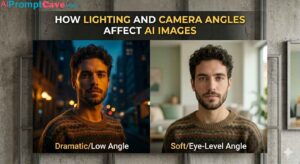
A small change in camera angle can transform an average image into something cinematic, premium, and visually powerful.
In this complete guide, you’ll learn:
- why camera angles matter in AI prompts
- the best camera angles for different image types
- how to describe angles in prompts
- common mistakes to avoid
- professional prompting techniques for better AI images
Why Camera Angles Matter in AI Images
Think about a movie scene.
A superhero standing heroically on a rooftop usually isn’t filmed straight-on.
Instead:
the camera shoots from below.
Why?
Because angle affects perception.
Camera perspective controls:
Emotion
How viewers feel.
Power
Whether the subject looks dominant or weak.
Realism
How natural the image feels.
Storytelling
How dramatic or immersive the scene becomes.
Product Appeal
How attractive products appear.
Without good perspective, even high-quality AI images feel generic.
What Is a Camera Angle in AI Prompting?
In AI prompting, camera angles describe:
where the virtual camera is positioned relative to the subject.
This influences:
- viewpoint
- composition
- focus
- depth
- storytelling
Example:
Bad prompt:
A luxury perfume bottle.
Better prompt:
Luxury perfume bottle photographed from a dramatic low angle with cinematic studio lighting and glossy reflections.
Same subject.
Completely different impact.
Eye-Level Angle
The eye-level shot is the most natural perspective.
The camera sits directly in front of the subject.
This feels:
- balanced
- realistic
- familiar
- professional
Best for:
- portraits
- ecommerce
- fashion
- lifestyle content
Example Prompt
Realistic portrait of a businessman, eye-level perspective, soft natural lighting, editorial photography style.
Eye-level angles create trust and neutrality.
They’re widely used in advertising.
Low Angle Shot
A low-angle shot means:
the camera looks upward.
This instantly makes subjects feel:
- powerful
- dominant
- heroic
- premium
Best for:
- fashion campaigns
- luxury products
- cars
- superheroes
- dramatic scenes
Example Prompt
Futuristic luxury sports car, photographed from a dramatic low-angle perspective, cinematic lighting, premium advertising style.
Low angles make subjects feel larger than life.
Luxury brands often use this technique.
High Angle Shot
A high-angle shot means:
the camera looks downward.
This often creates feelings of:
- vulnerability
- softness
- calmness
- storytelling intimacy
Best for:
- cozy scenes
- food photography
- lifestyle visuals
- room setups
Example Prompt
Cozy breakfast table photographed from a soft high-angle perspective, warm morning lighting.
High angles are extremely effective in food photography.
Bird’s-Eye View (Top-Down Shot)
This is one of the most useful AI perspectives.
The camera looks directly downward.
Also called:
flat lay photography
Best for:
- food photography
- ecommerce products
- desk setups
- travel gear
- skincare layouts
Example Prompt
Luxury skincare products arranged in a premium flat lay composition, bird’s-eye perspective, clean minimal background.
This angle feels modern and organized.
Very popular on social media.
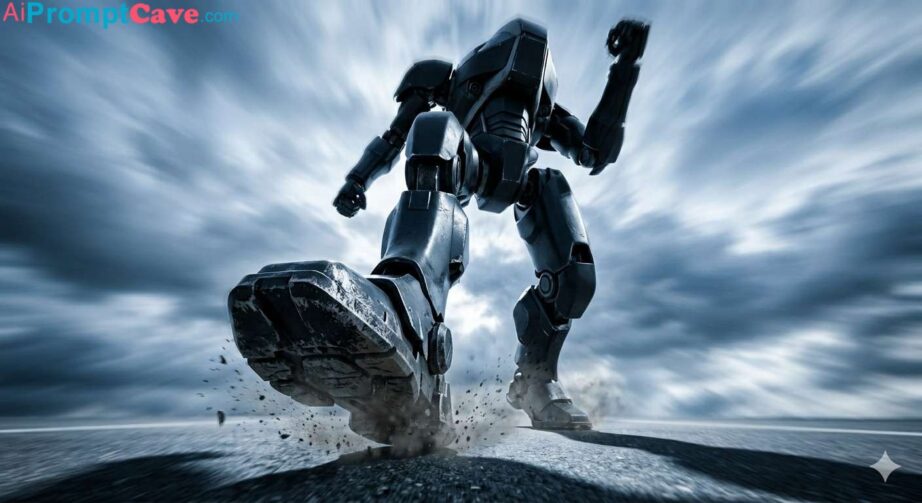
Worm’s-Eye View
This is an extreme low-angle shot.
The camera looks dramatically upward.
Creates feelings of:
- scale
- dominance
- intensity
Best for:
- architecture
- fantasy characters
- sci-fi scenes
- cinematic posters
Example Prompt
Giant futuristic robot viewed from an extreme worm’s-eye angle, cinematic atmosphere, dramatic shadows.
Very powerful for storytelling.
Over-the-Shoulder Shot
Common in films.
The camera frames the scene from behind someone’s shoulder.
Creates:
- immersion
- realism
- narrative depth
Best for:
- storytelling
- cinematic scenes
- gaming visuals
- conversations
Example Prompt
Over-the-shoulder shot of a detective looking at a neon city skyline, cinematic cyberpunk atmosphere.
This angle feels highly cinematic.
Close-Up Shot
Close-ups emphasize details.
Best for:
- emotions
- beauty ads
- luxury products
- food
Example Prompt
Extreme close-up of melted chocolate cake, macro photography, cinematic food lighting.
This creates richness and texture.
Luxury ads love close-ups.
Macro Shot
Macro photography focuses on tiny details.
Best for:
- jewelry
- food
- luxury textures
- product materials
Example Prompt
Macro lens shot of a luxury watch mechanism, detailed metallic textures, premium studio lighting.
Macro prompts dramatically improve realism.
Wide-Angle Shot
Wide-angle shots capture more environment.
Best for:
- landscapes
- architecture
- cinematic scenes
Example Prompt
Wide-angle cinematic shot of futuristic Tokyo streets during rain.
Adds scale and atmosphere.
Dutch Angle (Tilted Shot)
The camera tilts diagonally.
Creates:
- tension
- energy
- unease
Best for:
- action scenes
- thrillers
- dramatic storytelling
Example Prompt
Cyberpunk street battle photographed with a dramatic Dutch angle.
Use sparingly.
Too much feels chaotic.
Side Profile Angle
Perfect for elegance and realism.
Best for:
- portraits
- fashion photography
- luxury editorials
Example Prompt
Luxury fashion portrait of a man, side-profile composition, dramatic shadows.
Feels cinematic and premium.
Three-Quarter Angle
One of the best portrait angles.
The subject turns slightly.
Creates:
- realism
- dimensionality
- elegance
Best for:
- portraits
- influencers
- advertising
Example Prompt
Professional male portrait in three-quarter angle, cinematic lighting.
Often more flattering than straight-on shots.
Camera Angles for Product Photography
Different products benefit from different angles.
Electronics
Three-quarter angle.
Watches
Macro + low angle.
Perfume
Low dramatic angle.
Food
Top-down or close-up.
Furniture
Wide-angle perspective.
Cars
Low-angle cinematic shot.
Choosing the wrong angle can ruin product appeal.
Camera Angles for Food AI Images
Food photography depends heavily on angle.
Burgers & Tall Foods
Low angle.
Why?
Shows height and texture.
Pizza
45-degree angle.
Shows toppings.
Coffee
Top-down or eye-level.
Desserts
Macro close-up.
Example:
Cinematic burger photographed from a dramatic low angle, cheese melting in soft lighting.
Instantly more appetizing.
Camera Angles for Fashion AI Images
Fashion brands often use:
Low Angle
For confidence.
Three-Quarter Portrait
For realism.
Editorial Side Angle
For elegance.
Example:
Luxury male fashion editorial, low-angle photography, dramatic shadows, premium magazine style.
Fashion is all about confidence.
Camera Angles for Luxury Product Ads
Luxury brands often avoid flat eye-level shots.
Instead they use:
- dramatic low angles
- macro detail shots
- close-ups
- elegant perspective
Example:
Premium perfume bottle photographed from a cinematic low angle with reflective black marble surface.
Feels premium instantly.
Combining Camera Angle + Lighting
Camera angle alone is not enough.
Best prompts combine:
angle + lighting + lens + style
Weak:
Luxury car.
Better:
Luxury sports car photographed from a dramatic low-angle perspective, cinematic sunset lighting, shallow depth of field.
Much stronger.
Best Camera Keywords for AI Prompts
Useful keywords:
Perspective
- low-angle shot
- high-angle shot
- eye-level shot
- bird’s-eye view
- worm’s-eye view
Lens
- macro lens
- 35mm lens
- 50mm lens
- wide-angle lens
Composition
- cinematic framing
- editorial composition
- centered shot
- symmetrical framing
These keywords dramatically improve image quality.
Common Camera Angle Mistakes
1. No Camera Direction
Bad:
Futuristic city.
Better:
Wide-angle cinematic shot of futuristic city skyline.
2. Wrong Angle for Subject
Tall burger?
Don’t use top-down.
Use low angle.
3. Overusing Extreme Angles
Too much distortion looks unnatural.
Balance matters.
4. Ignoring Realism
Perspective must match physics.
Unnatural camera placement feels fake.
5. Forgetting Depth
Add:
shallow depth of field
Or:
cinematic focus
Creates realism.
Professional Prompt Formula
Use:
Subject + Camera Angle + Lens + Lighting + Style + Quality
Example:
Luxury gaming chair photographed from a dramatic low-angle perspective, 50mm lens, cinematic studio lighting, black-and-gold luxury advertising style, ultra-realistic.
This formula works extremely well.
Camera Angles for Different Emotions
Power
Low angle.
Vulnerability
High angle.
Intimacy
Close-up.
Drama
Dutch angle.
Luxury
Low angle + macro.
Calmness
Eye level.
Scale
Wide angle.
Camera perspective shapes emotion.
Why Professionals Care About Camera Angles
Professional photographers obsess over angles because:
perspective changes perception.
The same product can look:
- cheap
- luxury
- boring
- cinematic
- premium
Simply by changing camera placement.
AI follows the same principles.
Final Thoughts
Many people think better AI images come from:
better models.
But often:
better prompts create better images.
And one of the most overlooked prompt improvements is:
camera angle selection
Whether you’re creating:
- luxury ads
- food photography
- ecommerce visuals
- portraits
- cinematic scenes
the right camera perspective can dramatically improve quality.
Remember:
Eye-level = natural
Low-angle = powerful
High-angle = soft
Bird’s-eye = organized
Macro = detail
Wide-angle = scale
Master camera angles, and your AI images will instantly start looking more professional, cinematic, and visually impressive.
Read More : Ai Articles
Read More : How to Control Details in AI Image Generation
Read More : Advanced Tips for Nano Banana Tool
Read More : How to Use Negative Prompts Effectively
Read More : 100 Ready-to-Use AI Prompts for Daily Tasks
Read More : AI Prompt Styles: Cinematic, Realistic, Fantasy & More