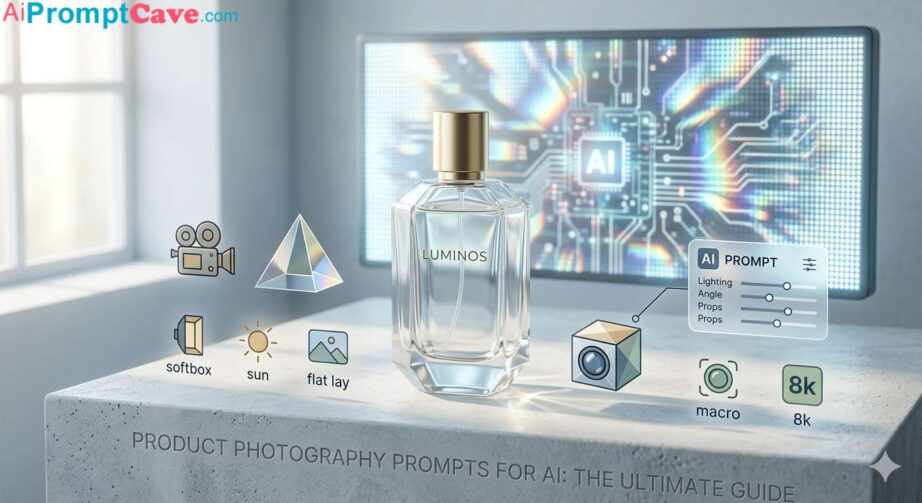
Artificial intelligence is transforming the world of product photography. What once required expensive cameras, professional studios, lighting equipment, and advanced editing skills can now be achieved with a well-written AI prompt.
From luxury cosmetics and fashion accessories to electronics and food advertisements, AI image generators are becoming powerful tools for creating stunning commercial visuals. However, the quality of the final image depends heavily on one thing:
The prompt.
A great AI product photography prompt can produce cinematic, high-end commercial images that look like they came from a professional advertising agency. A weak prompt creates flat, generic, low-quality results.
In this complete guide, you’ll learn how to write powerful AI product photography prompts, understand the key elements of professional commercial visuals, and create premium product images that look realistic, modern, and highly marketable.
What Are AI Product Photography Prompts?
AI product photography prompts are detailed text instructions used to guide AI image generators in creating commercial-style product images.
These prompts describe:
The product
Lighting
Materials
Camera angles
Background
Mood
Composition
Style
Advertising aesthetic
The goal is to make the AI generate an image that looks like professional product photography.
Why AI Product Photography Is Growing Fast
AI-generated product photography offers several advantages:
1. Lower Production Costs
Traditional product shoots require:
Cameras
Lenses
Studios
Lighting equipment
Editors
Models
AI removes most of these costs.
2. Faster Workflow
A single prompt can generate multiple campaign concepts in seconds.
3. Unlimited Creativity
AI allows impossible or surreal product compositions:
Floating products
Liquid explosions
Futuristic environments
Geometric visual effects
4. Easier A/B Testing
Brands can instantly create multiple advertising variations.
What Makes Great AI Product Photography?
Professional product photography usually focuses on:
Lighting
Composition
Material realism
Visual hierarchy
Brand identity
Emotional appeal
Your prompt must communicate all of these clearly.
The Anatomy of a Powerful Product Photography Prompt
A professional AI product photography prompt usually contains several layers.
1. Product Description
Start with the product itself.
Example:
“A luxury black perfume bottle with gold metallic details”
The more specific you are, the better.
2. Photography Style
Define the visual direction.
Common Styles:
Cinematic
Minimalist
Luxury commercial
Editorial
Studio photography
High-fashion advertising
Example:
“Luxury cinematic product photography”
3. Lighting
Lighting is critical in commercial visuals.
Popular Lighting Keywords:
Soft studio lighting
Cinematic lighting
Rim lighting
Dramatic shadows
Volumetric lighting
Example:
“Soft studio lighting with cinematic shadows”
4. Background & Environment
The environment affects mood and branding.
Examples:
Black reflective surface
Marble table
Futuristic room
Minimal studio background
Example:
“On a glossy black reflective surface”
5. Camera Perspective
Camera angles create depth and realism.
Examples:
Macro lens
Close-up shot
Low angle
Wide-angle commercial perspective
Example:
“Macro photography with shallow depth of field”
6. Texture & Material Details
Commercial realism comes from material quality.
Examples:
Glossy glass
Metallic texture
Frosted plastic
Condensation droplets
Example:
“Ultra-detailed glossy glass texture with realistic reflections”
7. Mood & Atmosphere
Mood creates emotional response.
Examples:
Luxury
Elegant
Futuristic
Fresh
Energetic
Example of a Strong Product Photography Prompt
“A luxury black perfume bottle with gold metallic accents placed on a glossy black reflective surface, cinematic studio lighting, dramatic shadows, ultra-detailed glass texture, macro photography, shallow depth of field, luxury commercial advertising style, 8K, hyper-realistic”
Types of AI Product Photography Prompts
1. Minimalist Product Photography
Minimalism emphasizes:
Clean layouts
Simplicity
Focus on the product
Example:
“Minimal luxury skincare bottle on a white background with soft shadows”
2. Luxury Commercial Photography
Luxury visuals use:
Dramatic lighting
Premium textures
High contrast
Example:
“Luxury watch advertisement with gold reflections and cinematic lighting”
3. Floating Product Photography
Floating compositions feel modern and dynamic.
Example:
“Floating sneaker surrounded by smoke and glowing particles”
4. Splash & Liquid Photography
Popular for beverages and cosmetics.
Example:
“Perfume bottle surrounded by floating water splashes”
5. Macro Product Photography
Macro shots reveal texture details.
Example:
“Extreme macro shot of melted chocolate texture”
6. Futuristic Product Photography
Perfect for tech products.
Example:
“Futuristic headphones in a neon cyberpunk environment”
Best Keywords for AI Product Photography
Keywords dramatically improve output quality.
Lighting Keywords
Cinematic lighting
Soft lighting
Studio lighting
Golden glow
Rim lighting
Volumetric light
Quality Keywords
Ultra-detailed
Hyper-realistic
8K
HDR
Sharp focus
Camera Keywords
Macro lens
Close-up shot
Shallow depth of field
Bokeh
Wide-angle lens
Material Keywords
Glossy
Metallic
Frosted glass
Reflective surface
Matte finish
Mood Keywords
Luxury
Elegant
Premium
Futuristic
Minimalist
Product Photography Prompt Templates
Luxury Product Template
“A luxury [product] on a reflective black surface, cinematic lighting, sharp highlights, ultra-detailed textures, luxury commercial photography, 8K”
Cosmetic Product Template
“A premium skincare bottle surrounded by water droplets and soft lighting, minimalist luxury aesthetic, macro product photography”
Beverage Product Template
“A floating energy drink can with liquid splashes, dramatic lighting, glossy reflections, hyper-realistic commercial advertising style”